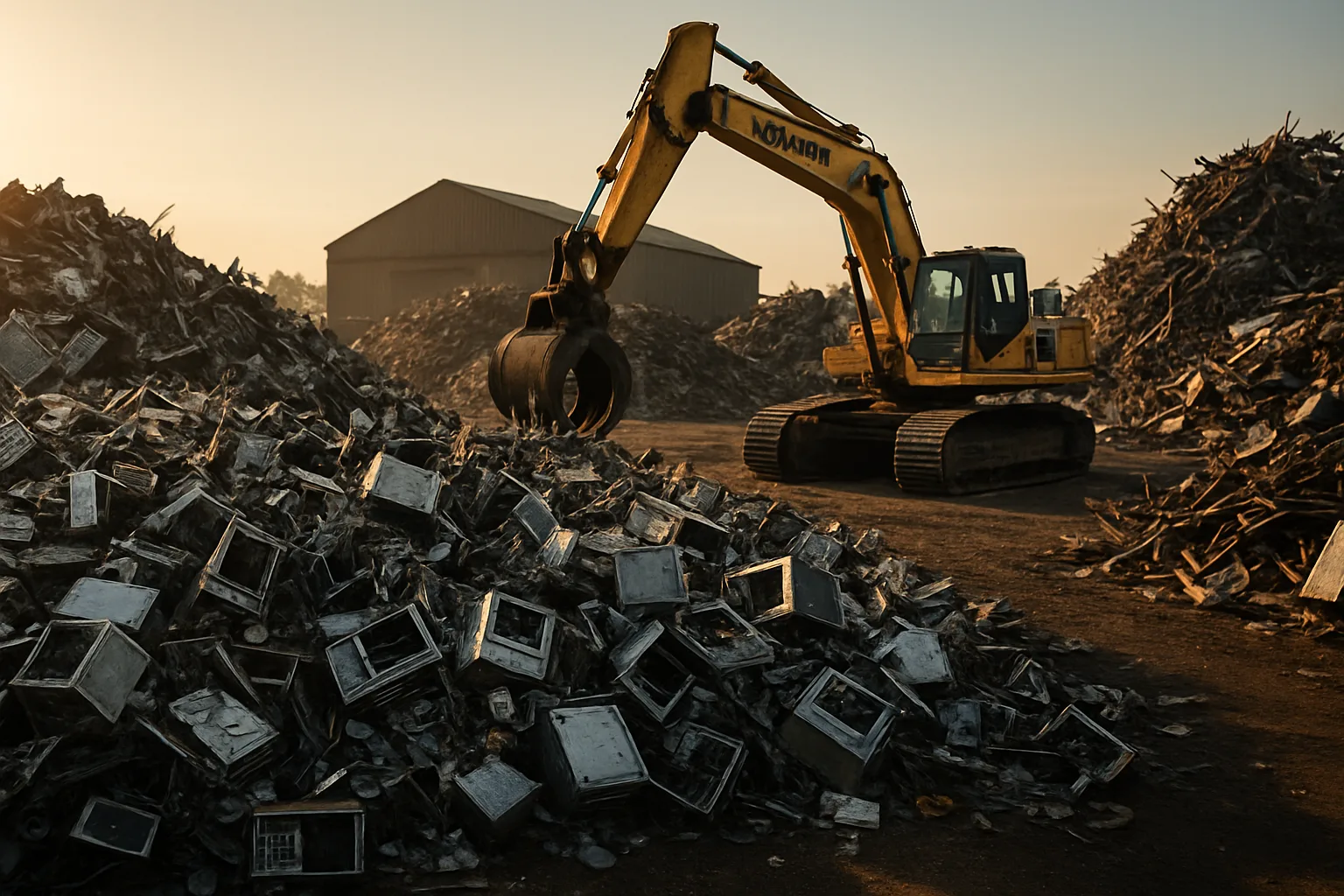
Your Old Electronics Are Worth More Than You Think — Here's What's Inside Them
Most people toss old laptops, phones, and circuit boards into a drawer or a donation bin. Big mistake. E-waste is one of the most metal-dense categories of scrap you'll ever handle — and most sellers completely overlook it. While you're focused on checking the aluminum scrap price today for your window frames and automotive sheet, there's a stack of precious metals sitting in your basement collecting dust.
This guide breaks down exactly which metals live inside old electronics, what they're worth, and how to recover maximum value — whether you're a yard operator in Windsor sorting incoming loads or a first-time seller trying to figure out what to do with a bin full of old computers.
E-Waste vs. Traditional Scrap: Why Electronics Demand a Different Approach
Traditional ferrous and non-ferrous scrap — steel beams, copper wire, aluminum extrusions — is straightforward. You weigh it, grade it, and price it. E-waste doesn't work that way. Electronics are composite materials: plastic housings, glass screens, aluminum chassis, copper-wound motors, gold-plated circuit contacts, and trace amounts of silver, palladium, and platinum all packed into a single device.
That complexity is exactly why most general scrap yards undervalue e-waste. They'll quote you an aluminum price on the chassis and ignore the rest. Specialized e-waste recyclers and competitive platforms change that equation. When you find the best Canadian scrap metal prices today, you need a channel that understands what's actually in the load — not just what it weighs.
Here's the key difference between the two approaches:
- General scrap yard: Prices the whole unit by bulk weight, usually at a low non-ferrous blended rate
- Specialized e-waste buyer: Separates and grades components — boards, transformers, hard drives, wire — and prices each stream individually
- Competitive auction platform (like SMASH): Puts your documented load in front of multiple vetted buyers, creating price discovery instead of guessing
The difference in payout can be significant. Documentation and separation matter more here than with almost any other scrap category.
The Precious Metals Hidden in Common Electronics — Ranked by Recovery Value
Let's get specific. Here's a ranked breakdown of the metals worth chasing in e-waste, from highest recovery value to lowest on a per-unit basis. This isn't theory — it's what experienced recyclers actually target when they break down a load.
- Gold — Found in CPU pins, connector contacts, SIM card contacts, and edge connectors on circuit boards. Quantities are tiny (fractions of a gram per unit) but gold's value per gram makes it worth pursuing at volume. Old military-grade electronics and server hardware carry the highest concentrations.
- Palladium — Multilayer ceramic capacitors (MLCCs) on circuit boards contain palladium. This is one of the least talked-about precious metals in e-waste, but palladium prices have been volatile and high in recent years, making those capacitors genuinely valuable at scale. Palladium also shows up in some older catalytic converters — another reason to sell catalytic converters online through a platform that knows what it's pricing.
- Silver — Keyboard membranes, switch contacts, some solar cells, and older CRT monitor components contain silver. Not as concentrated as gold, but silver accumulates quickly across large e-waste lots.
- Copper — This is the workhorse of e-waste. Power supplies, transformers, motor windings, and wire harnesses inside electronics all carry copper. A single desktop power supply can hold 200–400 grams of copper wire. Strip it properly and you're pricing it at copper wire grade, not blended e-scrap.
- Aluminum — Laptop and desktop chassis, heatsinks, and some phone bodies are aluminum alloy. While the aluminum scrap price today for these grades runs lower than copper or precious metals, volume adds up fast — especially on commercial lots. Ontario recyclers processing office equipment teardowns move serious weight in aluminum chassis alone.
- Steel and Iron — Server racks, appliance frames, and monitor stands are mostly steel. Lowest value per pound, but heavy. Don't ignore it — steel price still contributes to your total payout on large loads.
The Catalytic Converter Connection: E-Waste Isn't the Only Overlooked Source of Precious Metals
While we're talking about metals most sellers undervalue, catalytic converters deserve a mention in the same breath. Cats from vehicles contain platinum, palladium, and rhodium — the same family of metals found in e-waste circuit boards. And just like e-waste, most sellers getting one price from one buyer have no idea if that price reflects actual market value.
If you're already thinking about how to sell catalytic converters online for better pricing, the logic is identical to e-waste: documentation, separation, and competition between buyers produces better price discovery than a single phone call to a single yard. Platforms like smashrecycling.ca were built for exactly this problem — you document what you have, vetted buyers compete, and you see what the market actually pays.
For Windsor sellers specifically, this matters. You're close to a major automotive corridor, which means catalytic converters flow through yards constantly. Getting the right price on those cats — and on the aluminum and copper in your e-waste loads — can meaningfully move your monthly numbers. If you're looking for Windsor scrap metal services, check out Windsor scrap metal services for local pricing and options.
How to Prepare E-Waste for Maximum Scrap Value: A Practical Checklist
Showing up at a yard with a mixed bin of unsorted electronics is the fastest way to get a blended lowball price. Separation and documentation are your two biggest levers. Here's how to work a load before it ever hits a scale.
Sort by material stream first:
- Aluminum chassis and housings — separate from plastic-bodied units
- Copper wire and power supplies — strip or separate from boards
- Circuit boards (motherboards, RAM, GPUs) — keep together; these go to e-waste refiners
- Hard drives — some buyers want these whole for data destruction services; others want them stripped for aluminum platters and rare earth magnets
- CRT monitors — separate entirely; these have hazardous materials (lead glass) and require specific handling
- Lithium batteries — never mix with other streams; these are a fire hazard and require their own disposal channel
Document what you have: Photo documentation of your load by stream — not just a pile photo — gives buyers confidence. Platforms that support photo uploads and serial tracking (like SMASH) let buyers evaluate loads remotely, which opens your pool of potential buyers beyond whoever's physically nearby. That matters when you're trying to get best scrap metal prices Ontario-wide instead of just local.
Know your weights: Weigh each stream separately if possible. A mixed load loses value at the point where a buyer has to estimate ratios. An itemized load with documented weights gets priced more accurately — and usually higher.
Finding the Right Buyer: Scrap Yards, E-Waste Recyclers, and Online Platforms Compared
Not every e-waste load belongs at the same buyer. Here's how to match your material to the right channel.
General scrap yards work well for the aluminum chassis, steel frames, and copper wire you've already separated out. If you're searching for a scrap yard near me open on a weekend — or specifically a scrap yard near me open Sunday — a general yard handles the commodity metals efficiently. Just don't bring your unsorted circuit boards and expect precious metal pricing.
Specialized e-waste recyclers handle the circuit boards, hard drives, and mixed board lots that contain precious metals. They have the refining relationships to actually extract gold, silver, and palladium at commercial scale. The downside: they also tend to work on their own pricing schedules, and you're still dealing with a single buyer.
Online auction platforms introduce competition into both of these categories. When you list a documented load of circuit boards or sorted non-ferrous e-scrap with photo evidence on a platform like SMASH, multiple vetted buyers evaluate it. That competition is how you find out what a load is actually worth — not what one buyer decided to offer before you walked in the door. Read the latest Canadian scrap metal pricing guides to understand how different metals are trending before you commit to a buyer.
The best scrap metal prices Windsor sellers find consistently come from knowing which channel fits which material — and not defaulting to convenience over price.
What E-Waste Tells Us About Scrap Pricing Strategy Overall
E-waste is an extreme case of a problem that runs through all scrap metal selling: most sellers accept the first price they hear. One buyer, one call, done. That's the old way. It worked when prices were stable and relationships were everything. It doesn't work in a market where aluminum, copper, and precious metal prices move week to week and buyers price loads based on what they think you don't know.
The sellers getting best scrap metal prices Ontario-wide right now are the ones who treat every load like a documented transaction — photo evidence, material separation, weight records, and multiple buyer touchpoints. E-waste just makes that discipline more obviously rewarding, because the spread between a lazy sale and a prepared sale is higher here than almost anywhere else in scrap.
Whether you're running a yard in Windsor processing commercial teardowns, or a smaller operator sorting the occasional pallet of old servers, the principle is the same. Check current Canadian scrap metal prices before you decide what to do with any load — and build the habit of letting buyers compete instead of accepting the first number you hear.
Prices for all metals — aluminum, copper, steel, gold, palladium, and silver — fluctuate based on global commodity markets. Always verify current rates before selling. The information in this article reflects general market dynamics as of July 2026 and is not a guarantee of specific pricing.
If you want to stop leaving money on the table with every e-waste load, start at best-scrap-prices.ca — where you can find the best Canadian scrap metal prices today and connect with buyers who actually compete for your material.
Frequently Asked Questions
Q: Is the aluminum scrap price today the same for electronics chassis as for other aluminum scrap?
Not always. Aluminum grades vary — extruded aluminum, cast aluminum, and mixed aluminum alloys from electronics housings may price differently at a given yard. Always ask for a grade-specific price rather than a blended aluminum rate when selling laptop or desktop chassis. Separation and correct identification of the alloy can improve your payout.
Q: Where can I find the best scrap metal prices in Windsor for e-waste?
Windsor has several scrap yards that handle non-ferrous and general e-scrap. For materials with higher precious metal content — circuit boards, hard drives, catalytic converters — you'll generally get better price discovery using a competitive online platform rather than a single local yard quote. Checking current pricing at best-scrap-prices.ca before you go gives you a useful benchmark.
Q: Can I sell catalytic converters online the same way I'd sell e-waste scrap?
Yes. The process is similar — document what you have, photograph the units, and get multiple buyers involved. Platforms like SMASH let you list catalytic converter lots with photo documentation and serial tracking, which helps buyers price accurately and creates competition. This typically produces better outcomes than a single cold call to a local buyer.
Q: Is there a scrap yard near me open Sunday in Windsor or Ontario that accepts e-waste?
Some yards in Ontario do operate on Sundays, though hours vary by location and season. It's worth calling ahead, especially for e-waste, since not all general yards are set up to properly handle circuit boards or lithium batteries. For loads where price matters more than same-day turnaround, an online platform lets you list any day and connect with buyers on their schedule.
Q: How do I know if I'm getting the best scrap metal prices in Ontario for my electronics?
The fastest way is to check current market prices at best-scrap-prices.ca before you sell, and to get more than one offer on any significant load. Competition between buyers — not loyalty to one yard — is what drives price discovery. Documented, separated loads with clear photos consistently attract more competitive bids than unsorted mixed material.
Follow SMASH on LinkedIn for scrap metal market updates, pricing insights, and industry news: linkedin.com/company/scrap-metal-auction-sales-hub