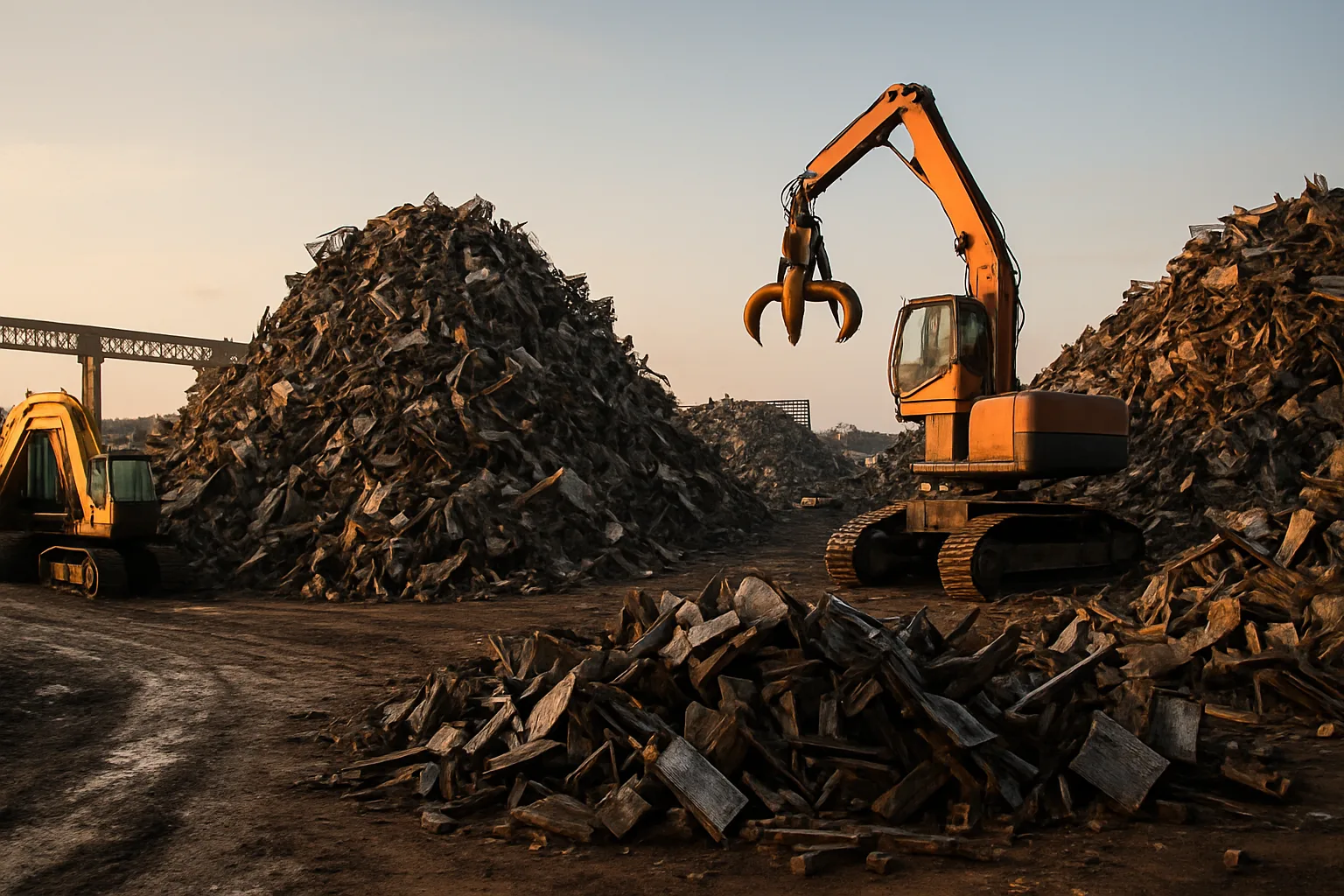
Why the Steel Scrap Price Today Has Nothing to Do With Your Neighbour's Offer
The price a local buyer quotes you for a load of steel often feels random. One week it's decent. The next, it drops and nobody explains why. Here's the reality: that number traces back to decisions made in Beijing, Frankfurt, and Washington — not just your nearest yard. Understanding why the steel scrap price today moves the way it does puts you in a better position to time your sales, negotiate, and stop leaving money on the table.
This guide breaks down the global forces that shape Canadian scrap metal prices, what that means for sellers in Sherbrooke and across Quebec, and how to use that knowledge to your advantage.
Global Steel Production Drives Local Scrap Metal Prices Today
Steel mills don't make steel from nothing. About 30% of global steel production uses recycled scrap as a primary feedstock — and electric arc furnace (EAF) mills use even more. When production ramps up in major steel-producing countries, demand for scrap rises globally. When those same mills cut output, scrap piles up and prices soften.
In 2026, global steel dynamics are being shaped by ongoing shifts in manufacturing capacity across Southeast Asia, a slower-than-expected European industrial recovery, and continued volatility in U.S. tariff policy on imported steel. Each of those factors feeds directly into what you see when you check current Canadian scrap metal prices on any given morning.
- U.S. tariff policy: When the U.S. restricts steel imports, domestic mills lean harder on scrap. Canadian exporters feel that demand almost immediately.
- Chinese production cycles: China remains the world's largest steel producer. When they curtail output for environmental or economic reasons, global scrap demand tightens.
- Currency exchange: The CAD/USD rate affects the competitiveness of Canadian scrap on export markets. A weaker loonie can actually work in sellers' favour — for a while.
None of this is abstract. A foundry buyer in Hamilton or a dealer in Montreal tracks these numbers daily. The seller in Sherbrooke who understands the same signals is a smarter negotiator.
Copper, Aluminum, and Non-Ferrous Prices Follow Different Global Signals
Steel isn't the only metal affected by global economics. Non-ferrous metals — copper, aluminum, stainless steel, brass — trade on commodity exchanges and respond to their own supply and demand pressures. Copper pricing is deeply tied to construction activity, electrical infrastructure investment, and EV manufacturing demand. Aluminum tracks aerospace, automotive, and packaging sectors.
In 2026, copper remains one of the most traded non-ferrous metals in the recycling market. Global grid infrastructure spending and the continued growth of electric vehicle production have kept copper demand elevated. That has a direct effect on what recyclers in Quebec can get per pound on clean copper wire versus insulated cable.
Aluminum tells a different story. With primary aluminum smelting energy-intensive and subject to power cost swings, recycled aluminum has become increasingly attractive to manufacturers. Quebec's industrial base — particularly its proximity to automotive supply chains and manufacturing corridors — means aluminum scrap generated locally has genuine buyer interest behind it.
If you're managing a mixed load of non-ferrous material, having clean documentation and sorted inventory makes a measurable difference. Platforms like SMASH help sellers present loads professionally to buyers who can actually bid competitively on the material — not just whatever a single local contact offers that day.
How Scrap Metal Inventory Management Affects What You Actually Receive
Here's a gap most sellers don't think about: even when the global market is strong, a poorly documented load undercuts your price. Buyers price uncertainty into their bids. If they can't verify grades, weights, or contamination levels before committing, they discount. That discount comes out of your payout.
Good scrap metal inventory management is how you close that gap. That means:
- Sorting by grade — mixed loads get mixed prices. #1 copper shouldn't be priced like #2 because it's tangled up with insulated wire.
- Accurate weight estimates — buyers trust sellers who know what they have. Guessing creates friction.
- Photo documentation — clear images of the load reduce buyer hesitation and support better bids.
- Serial tracking for high-value items — catalytic converter cores, for example, benefit from VIN or serial tracking that confirms identity and grade before sale.
SMASH builds these tools directly into the platform. Inventory tracking, photo documentation, and serial number logging aren't add-ons — they're part of how a listing gets prepared for auction. When a buyer in another province or across the border sees a clean, documented load with photos, they bid with more confidence. More confidence means more competitive bids.
For Sherbrooke scrap metal services, having this level of documentation readiness matters — especially when you're trying to access buyers beyond the immediate local market.
What the SMASH Scrap Metal Auction Model Does Differently
The traditional approach to selling scrap in Sherbrooke or anywhere else in Quebec is simple: call your buyer, get a quote, take it or leave it. If that buyer is having a slow week, you absorb their margin. You have no visibility into what anyone else would have paid.
The SMASH scrap metal auction model replaces that with competition. Multiple vetted buyers see your load. They bid. The market reveals itself — you don't have to guess. That's not a pitch. That's just how price discovery works when you expose a load to more than one buyer.
A few things that make this relevant to the current market environment:
- Global price volatility makes real-time competitive bidding more valuable, not less. When the steel scrap price today is moving fast, you want the current market — not a quote from yesterday.
- Vetted buyers mean you're not dealing with unknown counterparties. SMASH screens buyers before they access auctions.
- Auto-invoicing and documentation reduce the administrative friction that slows down high-volume operations.
- No subscription fees. SMASH earns when the seller earns. That alignment matters.
You can sell your scrap metal on SMASH Recycling and access a buyer pool that extends well beyond your local market — which is exactly what you need when global conditions are shifting the floor on local prices.
Reading Market Signals: When to Sell and When to Hold
Timing the scrap market perfectly isn't realistic. But reading directional signals is absolutely possible — and it's what experienced sellers do. Here are the indicators worth watching in 2026:
U.S. manufacturing PMI: When U.S. manufacturing activity expands, demand for steel and non-ferrous metals typically follows. A rising PMI often precedes stronger scrap demand from American buyers, which lifts Canadian export pricing.
LME copper and aluminum spot prices: The London Metal Exchange sets global benchmarks. When LME copper is trending up, your non-ferrous loads are worth more — even at the local level. Checking these prices takes two minutes and gives you real context before you negotiate.
Seasonal demand cycles: Construction ramps up through spring and summer across Canada. Steel demand from construction-adjacent supply chains tends to support scrap pricing during those months. Fall and winter often see softer demand as project activity slows.
Freight and logistics costs: Shipping scrap costs money. When fuel prices spike or carrier capacity tightens, buyers factor logistics into their bids. A load that's well-documented and ready to move is more attractive than one that requires extra handling time.
To find the best Canadian scrap metal prices today, you need to track both what's happening globally and what's happening in your own yard. The two are connected — and understanding that connection is what separates sellers who consistently do well from those who just hope the quote is fair.
For ongoing market context and pricing guidance, read the latest Canadian scrap metal pricing guides — updated regularly to reflect current conditions.
Scrap Metal Prices in Sherbrooke: Local Context, Global Inputs
Sherbrooke sits in the Eastern Townships of Quebec, in a region with a mixed industrial and manufacturing base. Local scrap generation comes from construction activity, manufacturing operations, auto recyclers, and light industrial sources. That material doesn't just stay local — it moves through dealer networks, processing yards, and export channels that plug directly into North American and global markets.
What that means practically: the scrap metal prices today you're quoted locally in Sherbrooke are influenced by the same global signals affecting yards in Toronto, Calgary, or Detroit. A Quebec seller who treats their load as a purely local transaction is likely underpricing it. A seller who approaches it with market awareness — and the right platform — has access to the same buyer competition that larger operations use to protect their margins.
Quebec's industrial history and its proximity to major corridor markets (Montreal, the U.S. Northeast) mean there are real buyers interested in material generated here. The question is whether those buyers can find your load — and whether they can compete for it.
If you want to move beyond a single local offer and actually see what the market will bear for your steel, copper, aluminum, or catalytic converter cores, the tools exist. Use them.
When you're ready to stop guessing and start pricing with confidence, check rates and market data at best-scrap-prices.ca — and take the next step toward getting what your material is actually worth.
Frequently Asked Questions
Q: What determines the steel scrap price today in Sherbrooke?
The local price reflects a combination of global steel market conditions, domestic demand from Canadian mills, U.S. export market activity, and the CAD/USD exchange rate. Local buyers set their prices based on what they can get when they resell the material — which means global inputs matter even at the yard level in Sherbrooke.
Q: Why do scrap metal prices change so frequently?
Scrap metals are commodities. They trade on global exchanges and respond to changes in manufacturing output, construction activity, currency movements, and trade policy — sometimes daily. Major events like tariff announcements or shifts in Chinese steel production can move prices within hours of the news hitting.
Q: How can I get better scrap metal prices in Quebec than what my local buyer offers?
The most effective way is to expose your load to more than one buyer. Competitive bidding through a platform like SMASH gives multiple vetted buyers the chance to bid on your material. More competition generally leads to better price discovery than a single take-it-or-leave-it quote from one contact.
Q: Does sorting my scrap before selling actually make a difference in price?
Yes — significantly. Mixed, unsorted loads get discounted because buyers price in the labour and uncertainty of sorting it themselves. Clean, graded, and documented loads command better bids. Separating copper grades, aluminum alloys, and ferrous from non-ferrous before listing is one of the simplest ways to improve your payout.
Q: Is it worth selling scrap metal from Sherbrooke to buyers outside of Quebec?
Absolutely. Many of the strongest buyers for Canadian scrap operate across provincial and national borders. Export demand from U.S. mills and processors can offer competitive pricing — particularly for non-ferrous metals like copper and aluminum. Using a platform that connects you to vetted buyers across North America means geography stops being a limitation.
Disclaimer: Scrap metal prices fluctuate daily based on market conditions. The information in this article reflects general market dynamics as of June 2026. Always check current rates before making buying or selling decisions.
Stay current on scrap metal market trends and pricing insights — follow SMASH on LinkedIn for regular industry updates.